
The first time people hear about mutual funds, there is one term that keeps coming up – SIP. But before you jump into schemes, returns or calculators, it is better to pause and understand the SIP meaning clearly, as that forms the base for anything that follows.
What is the meaning of SIP?
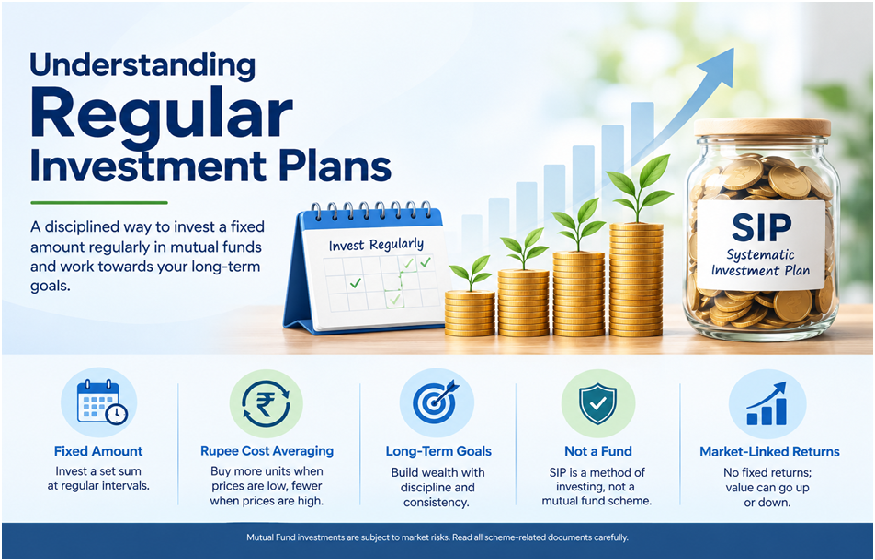
SIP full form is Systematic Investment Plan, a disciplined investment plan of fixed amount in a mutual fund scheme at regular intervals. You don’t put all your money in at one time. You spread it out over a number of payments – weekly, monthly or quarterly depending on what the scheme you are using allows.
What SIP signifies, at its heart, is consistency. You don’t try to pick the “perfect” moment to invest. You stick to a routine and you stick with it for a long time.
Read More: Strategic Investment Planning Ideas for Modern Indian Investors
In addition to the literal definition
The technical meaning of SIP is the process of investing on an instalment basis. But it is equally important to know what SIP is not:
- It is not the mutual fund scheme; it is a way of investing in one.
- It does not give a fixed and guaranteed return like a bank recurring deposit.
- It doesn’t make an unsuitable fund suitable for your objective. Scheme selection still matters.
This knowledge of the differences will help you in avoiding the common misconceptions that new investors tend to have in their first SIP.
How the Underlying Mechanism Operates
Whenever your SIP instalment is processed, it purchases units of the mutual fund scheme of your choice at the Net Asset Value (NAV) prevailing on that day. When the NAV is lower, your fixed amount of money buys more units, and when the NAV is higher, it buys fewer units. That averages your overall purchase cost over time and is called rupee cost averaging.
This is one of the reasons why the meaning of SIP is often linked to reducing the pressure of trying to time market movements. You keep investing through the ups and downs of the market, rather than waiting for some perfect entry point that may never come.
Why Meaning Matters for Your Financial Planning
Knowing the true meaning of SIP changes the way you look at your financial objectives. Instead of looking at it as a fast or surefire route to riches, you start to see it as a long-term, systematic commitment, one that matches a clear goal, an appropriate investment time frame, and a strategy that matches your risk tolerance.
It also helps to remember that SIP returns are linked to the market all through, so there will be periods of negative or flat returns, especially over shorter durations.
Read More: Why Long-Term Financial Decisions Deserve More Attention During Major Life Changes
Learn more about the concept
To get the complete picture, including types of SIP, benefits and how to choose the right scheme, read our comprehensive SIP Guide, where each aspect is explained in detail.
Judge for yourself – the numbers
Once the meaning becomes clear, it can help to visualize how your instalments might grow over different time horizons. Use the SIP Calculator to model your own investment amount & tenure.
Endnotes
The meaning of SIP is more than a definition; it is a mindset of regular and disciplined investment for long-term goals. This guide, brought to you by Tata Mutual Fund, is meant to help you build that understanding before you take your next investing step.
Please be aware that investments in mutual funds are subject to market risks. Read all scheme documents carefully.